Hepatitis B virus (HBV) infection can lead to acute or chronic inflammatory liver disease and remains a major risk factor for hepatocellular carcinoma (HCC). Stable HBV animal models are therefore essential for studying HBV pathogenesis and supporting anti-HBV drug screening and preclinical efficacy evaluation. Jennio Biotech provides customized HBV mouse model services to support hepatitis B drug research and development.
Jennio Biotech provides customized HBV model construction services that stably simulate the pathological state of persistent HBV infection in vivo. These HBV animal models are applicable to anti-HBV drug screening and preclinical efficacy evaluation, delivering precise and reliable integrated technical support for hepatitis B drug research and development (R&D) and helping accelerate the development of innovative antiviral drugs.
Short modeling cycle: A stable chronic HBV infection state can be established within 4-8 weeks.
Non-transgenic approach: No reliance on transgenic animals, enabling convenient model construction with broad applicability.
High disease relevance: The model highly mimics the pathological features of persistent HBV infection in humans.
Excellent reproducibility: The model demonstrates strong batch consistency and outstanding experimental repeatability.
HBV Mouse Model Platform Capabilities
Technology Platform
Stable HBV model establishment system: AAV-mediated infection can be accurately controlled, with an infection success rate of over 90%.
Pseudovirus packaging platform: Supports biosafety research on high-risk viral targets, including SARS-CoV-2, under BSL-2 conditions.
Infrastructure and Testing Support
SPF-grade animal facility and ABSL-2 laboratory: Equipped to support high-risk research with in vivo imaging systems, hematology analyzers for multiple viral monitoring indicators, ventilators, and other essential instruments for real-time study support.
Titer detection: High viral titers are used to help ensure model stability and consistency.
Model Validation
Broad application coverage: The platform supports full-chain evaluation across bacteria, viruses, and fungi.
Clinical relevance: Model performance has been validated through multiple detection methods, including histopathology (H&E staining), biochemical indicators, and virological indicators.
HBV Mouse Model Service Process and Support
Jennio Biotech provides a standardized and efficient service workflow for HBV mouse model construction, study execution, and data delivery, with integrated support throughout the full project lifecycle.
1. Project Communication
Customized study design based on target type, infection challenge site, and assessment metrics.
2. Model Execution and Monitoring
The rAAV-HBV mouse model is established according to a standardized workflow to ensure stable and controllable experiments. Real-time updates on model establishment and study execution, such as DAI score and monthly burden, are shared throughout the project.
3. Data Delivery
GLP-compliant reports can be delivered within 7-14 days, including raw data, statistical analysis, and pathological slides.
4. Service Support
One-stop full-process service covering model construction, dosing regimen design, sample detection, and statistical analysis.
Professional positive control setup using first-line drugs such as entecavir and tenofovir for parallel efficacy evaluation.
Full lifecycle support from early screening to IND-enabling data packages.
Efficient delivery, with standard model cycles 30% faster than the industry average.
Resource integration supported by a library of more than 1,000 varieties to meet diverse research needs.
Quality Control and Compliance
Certifications: SPF animal facility certification and laboratory animal use permit.
Quality control measures: Double-blind data review and third-party cross-validation, such as comparing HBsAg detection with commercial kits.
Compliance standards: Conducted in accordance with FDA and EMA guidelines for anti-infective drug evaluation, with data traceable to original records.
Compliant data management: Implemented in accordance with NMPA and ICH non-clinical research guidelines, supporting project initiation, internal assessment, and subsequent IND compliance.
Laboratory Support:The Class 10,000 clean animal facility can accommodate high-risk animals and process more than 100 samples per day. The isolation platform helps ensure the sterility of viral preparations and meets GMP standards.
HBV Mouse Model Application Scenarios
Preclinical in vivo screening and preliminary efficacy evaluation of innovative anti-HBV small-molecule compounds and candidate drugs.
Efficacy comparison and dose optimization of nucleoside and nucleotide candidate drugs.
In vivo efficacy evaluation of novel anti-HBV modalities, including small nucleic acids and peptides.
In vivo antiviral effect verification of new delivery vectors and formulations for hepatitis B.
Comprehensive assessment of candidate drug efficacy and safety, providing data support for project initiation, regimen optimization, and subsequent compliant non-clinical studies.
Who We Serve
We provide professional HBV model construction and efficacy evaluation services for biopharmaceutical companies, biotechnology enterprises, new drug R&D institutions, and vaccine-related organizations engaged in the development of innovative anti-hepatitis B drugs and formulations.
HBV Mouse Model Case Study
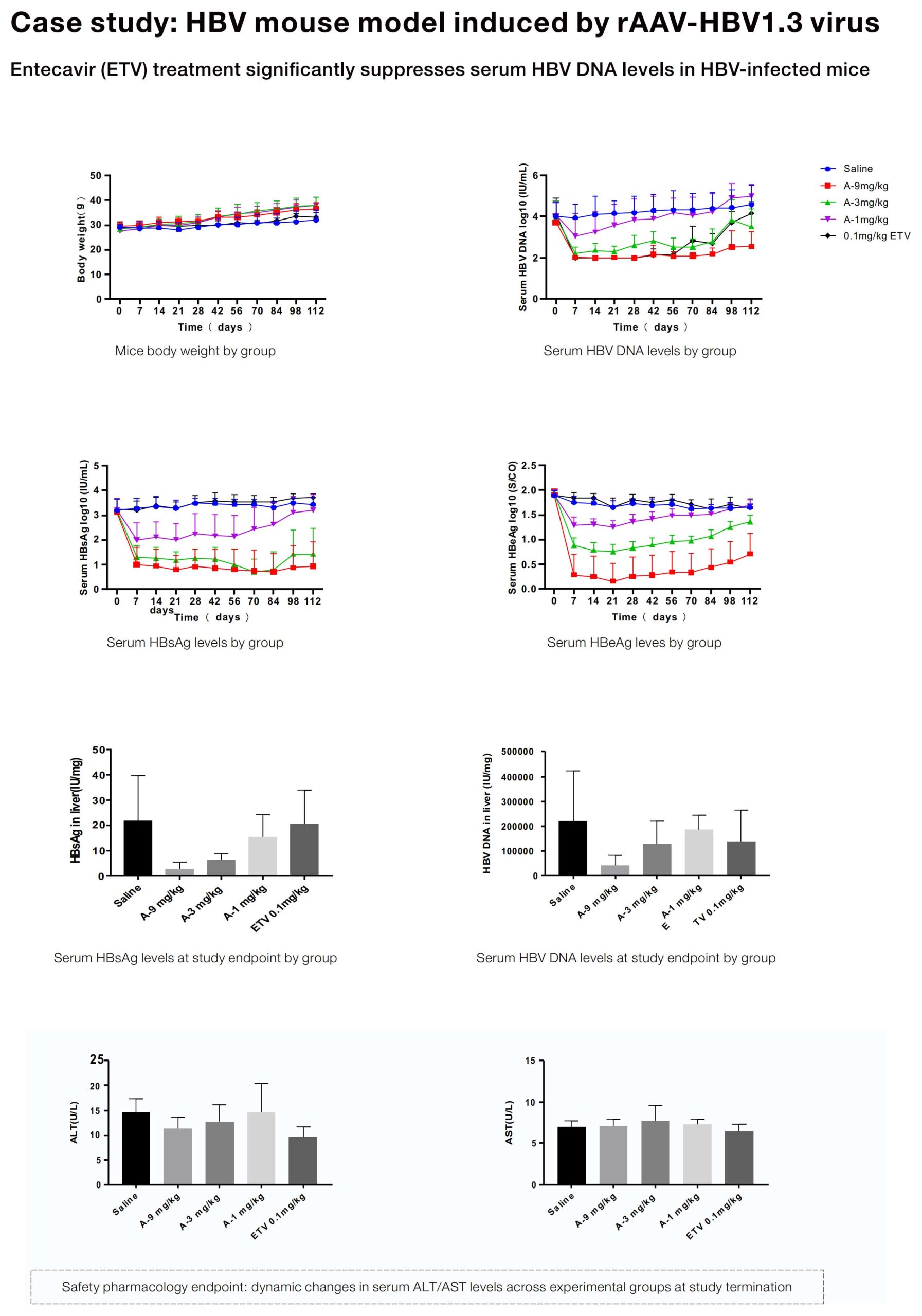
The rAAV-HBV mouse model is used for HBV efficacy evaluation. Drug intervention is initiated after 6 weeks of stable model establishment to assess the anti-HBV activity of test articles across dose groups. Entecavir (ETV), a marketed nucleoside analog, can be used as a positive control for parallel efficacy comparison, allowing clear observation of anti-HBV activity and dose-dependent response relationships.
Detection Indicators
Comprehensive detection and evaluation can be performed simultaneously across serological and virological indicators, hepatic viral nucleic acid and protein indicators, and overall animal safety-related indicators.
HBV Mouse Model FAQs
What is an rAAV-HBV mouse model?
An rAAV-HBV mouse model is established using recombinant adeno-associated virus-mediated delivery to generate stable HBV expression in mice, making it suitable for anti-HBV drug evaluation and efficacy studies.
How long does HBV mouse model establishment take?
A stable chronic HBV infection state can typically be established within 4-8 weeks, depending on study design and model requirements.
What applications are suitable for an HBV mouse model?
HBV mouse models are suitable for anti-HBV small-molecule screening, dose optimization, evaluation of nucleic acid and peptide therapeutics, and antiviral assessment of delivery systems and formulations.
What endpoints can be evaluated in an HBV mouse model study?
Evaluation endpoints may include serological and virological indicators, hepatic viral nucleic acid and protein markers, histopathology, biochemical indicators, and animal safety-related observations.
Can positive controls be included in HBV efficacy studies?
Yes. First-line drugs such as entecavir and tenofovir can be used as positive controls for parallel efficacy comparison.
What support is provided during an HBV mouse model study?
Jennio Biotech provides integrated support covering model construction, study execution, sample detection, statistical analysis, and data delivery to support anti-HBV drug research and development..
Hepatitis B virus (HBV) infection can lead to acute or chronic inflammatory liver disease and remains a major risk factor for hepatocellular carcinoma (HCC). Stable HBV animal models are therefore essential for studying HBV pathogenesis and supporting anti-HBV drug screening and preclinical efficacy evaluation. Jennio Biotech provides customized HBV mouse model services to support hepatitis B drug research and development.
Listen to the voice of every customer
Share details of your inquiry, and we’ll contact you shortly.
Contact us
Room 238, Building A, Guangzheng Science and Technology Park, No. 11 Nanyunwu Road, Huangpu District, Guangzhou, Guangdong Province, China