
Non-GLP Pharmacology and Toxicology Research

Non-GLP Pharmacology and Toxicology Research

Categories:

Before clinical trials, it is essential to study the potential toxicity of candidate drugs in order to identify any adverse effects. The purpose of preclinical safety assessment is generally to determine the toxic effects on target organs, dose dependency, the relationship between compound exposure, and to identify potential reversibility. All these data will be used to establish a safe starting dose for clinical trials and determine parameters for monitoring potential adverse reactions during clinical monitoring. However, if conducting large-scale toxicity and safety studies in GLP (Good Laboratory Practice) facilities without initial knowledge of the effective dose and safety dose of the test substance may lead to dose adjustments and repetition of subsequent efficacy tests, which may result in increased risks and significant escalation of research costs.
Jennio has pharmacology and toxicology experts with years of experience in GLP facilities for preclinical projects. We can design tailored toxicity and safety studies for clients in the early stages of identifying effective drug doses. These studies can provide preliminary characterization of the drug safety dose and potential toxic target organs, which provides data support for subsequent preclinical safety research.

Details

1、High Drug Development Failure Rate? Non-GLP Pharmacological and Toxicological Studies Accelerate Preclinical Decision-Making and Reduce R&D Risks

  • Industry Pain Point: Traditional drug development often faces high failure rates in later stages due to toxicity or efficacy issues, resulting in significant time and cost inefficiencies.
  • Value Proposition: Utilizing a customized and efficient non-GLP study platform, we enable rapid assessment of drug safety and efficacy, shortening the R&D cycle by 30% and delivering key data to support IND submissions.

2Service Overview

A Crucial Phase in Preclinical Drug Safety and Efficacy Evaluation

  • Positioning: Non-GLP pharmacological and toxicological studies serve as a pivotal stage prior to clinical trials, focusing on drug safety (acute/chronic toxicity) and pharmacodynamics (PD/PK) assessment.
  • Industry Pain Point: Traditional methodologies are often time-consuming, costly, and struggle to accurately simulate human responses.
  • Core Objective: By leveraging standardized animal models and a multidimensional testing platform, we deliver highly predictive data to reduce the risk of clinical failure.

3、Our Services

By Research Phase and Application Scenario: Covering Full-Process Needs

  • Acute Toxicity Study
    • Application: Single-dose safety assessment.
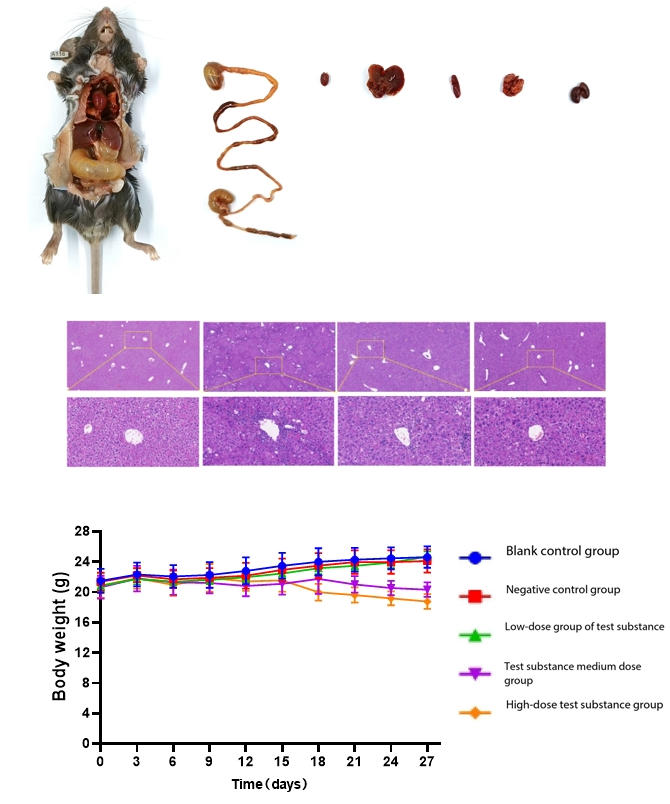
    • Key Endpoints: Animal behavioral observation, blood biochemistry (AST/ALT), histopathology (H&E staining).
  • Chronic Toxicity Study
    • Application: Repeat-dose toxicity (4-13 weeks).
    • Key Endpoints: Body weight changes, organ coefficients, hematology, histopathology.
  • Pharmacokinetic (PK)/Pharmacodynamic (PD) Studies
    • Techniques: Quantification of plasma drug concentrations and tissue drug levels via High-Performance Liquid Chromatography (HPLC), determination of pharmacokinetic parameters including half-life (T₁/₂) and clearance (CL).

4Technology Platforms and Advantages

GLP-Aligned Technology System Ensuring Data Reliability

  • Technology Platforms
    • Flow Cytometry Platform: Detection of cell apoptosis, cycle, and inflammatory cytokines (TNF-α, IL-6).
    • Molecular Detection Platform: qPCR, WB.
  • Infrastructure
    • SPF-Grade Animal Facility: Capacity for 5,000 mouse/rat cages, compliant with AAALAC standards.
    • BSL-2 Laboratory: Supports pathogen infection models (e.g., Staphylococcus aureus endocarditis).
  • Differentiated Advantages
    • Matrix Resources: 300+ PDX sample library, 1,000+ cell lines, enabling multi-dimensional model construction.
    • Cross-Species Models: Full coverage of mouse, rat, and rabbit models.

5Service Process

Transparent Collaboration with 48-Hour Rapid Response

  • Requirement Communication: Provide tailored proposals within 24 hours, clarifying models, testing indicators, and timelines.
  • Experimental Execution: Share progress in real time (VR mini-program oversight) and visualize data at key milestones.
  • Data Delivery: Deliver comprehensive reports within 7–10 business days, including raw data, statistical analysis, and pathological section images.

6Quality Control and Compliance

GLP-Aligned Standards with Data Traceability

  • Compliance Standards: Experimental designs adhere to FDA, EMA, and NMPA regulations, and execution follows GLP-aligned processes.
  • Quality Control: Double-blind data review and third-party cross-validation (e.g., STR profiling for cell lines).
  • Equipment Calibration: Regular maintenance of key equipment such as flow cytometers and HPLC systems.

7Case Studies

Empowering Pharmaceutical R&D with Data-Driven Decisions
  • Case 1: Repeat-Dose Toxicity Study of a Small-Molecule Drug
    • Process: A 28-day continuous dosing study in SD rats, conducted under a GLP-referenced project management system.
    • Result: The test substance demonstrated significant liver and kidney toxicity.
  • Case 2: Efficacy Validation of an Anti-Infective Drug
    • Model: Staphylococcus aureus endocarditis rat model.
    • Result: The treatment group showed a 40% increase in survival rate and a 50% reduction in inflammatory cytokine (IL-1β) levels, as detected by flow cytometry.
    • View More Cases: Jennio Efficacy Evaluation Handbook.


8Collaboration Advantages

One-Stop Solution Balancing Efficiency and Flexibility

  • Customization: Tailored protocols for different drug types (small molecules/biologics), supporting projects from early screening to IND submission.
  • Fast Turnaround: Acute toxicity studies completed in 10–15 business days, 30% faster than industry average.
  • End-to-End Support: Integrated services covering model establishment, testing, and data analysis, reducing client coordination efforts.

9FAQ

  • Q1: Are cross species models supported?

A: Yes, we support customized models in mice, rats, rabbits, and non-human primates (NHPs).

  • Q2:Is expedited data delivery available?

A: Expedited service is available (additional 30% fee), with delivery in as fast as 5 business days.

  • Q3: Are special formulations (e.g., nanomedicines) supported?

A: We have expertise in toxicity assessment of nanocarriers (particle size/stability analysis).

10Laboratory Highlights

Professional Facilities Ensuring High-Precision Output

  • Automated Workstations: SPF animal housing equipped with workstations to maintain a sterile environment
  • In Vivo Imaging Systems: Real-time monitoring of tumor growth
  • View Laboratory Panorama:

11Contact Us

24-Hour Response, Free Consultation to Start Collaboration

  • Email: 3691125803@qq.com
  • : +86 18802035152
  • Download booklet:Download Service Handbook at: https://www.jennio-bio.com/contact-us/
  • Additional Resource: Whitepaper on Pharmacological and Toxicological Research.


Listen to the voice of every customer

Share details of your inquiry, and we’ll contact you shortly.​

Contact us

Room 238, Building A, Guangzheng Science and Technology Park, No. 11 Nanyunwu Road, Huangpu District, Guangzhou, Guangdong Province, China

Business Cooperation

3691125803@qq.com

Mobile phone number/WeChat ID

+86 18802035152