

Positioning: Cas9 gene-edited cell lines are core tools for preclinical drug target validation and mechanism research, directly influencing the evaluation of the efficacy and safety of drug candidates.
Industry Pain Point:
Solutions:
Precisely construct gene knockout/overexpression cell lines via CRISPR-Cas9 technology, and combine with functional verification to provide in vitro models that highly recapitulate disease mechanisms for efficacy evaluation, accelerating the entire process from target discovery to IND application.
Technical Solutions Categorized by Application Scenario:
| Service Type | Technical Details | Application Scenarios |
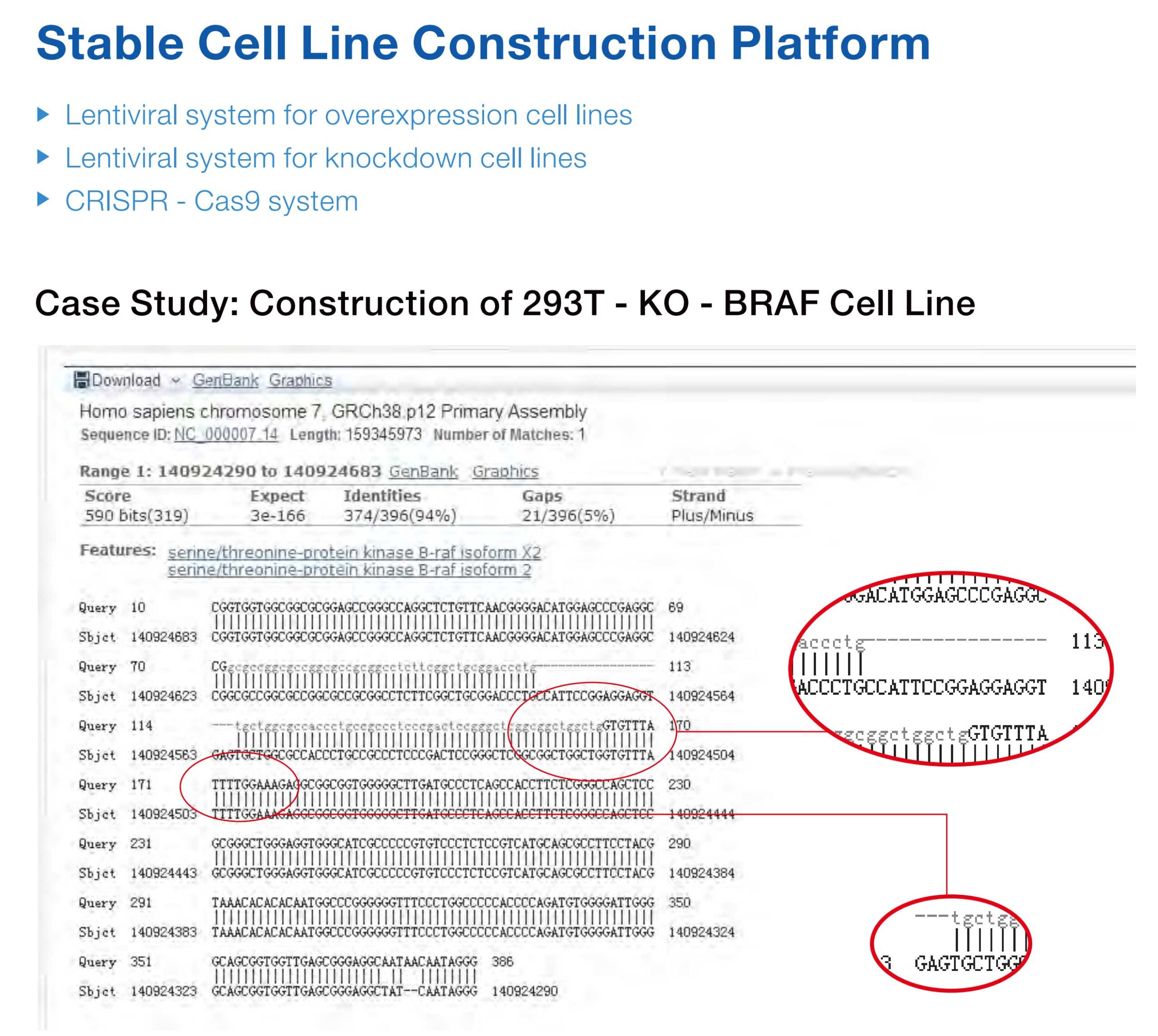
| Gene Knockout Cell Lines | sgRNA design + Cas9 vector construction, monoclonal screening (efficiency ≥80%), delivery of sequencing-verified KO cell lines. | Tumor drug resistance mechanism research, target loss-of-function validation. |
| Gene Overexpression Cell Lines | Lentiviral/plasmid vector-mediated, stable cell line construction (fluorescent/drug-resistant markers optional), qPCR/WB verification of expression levels | Efficacy evaluation of therapeutic antibody target activation |
| Point Mutation Cell Lines | Introduction of specific base mutations using CRISPR prime editing technology | Construction of kinase inhibitor resistance models |
| Custom Tool Cell Lines | Custom reporter gene cell lines (e.g., Luciferase, GFP labeling) based on high-transfection efficiency cells such as 293T/HEK293 | Development of high-throughput drug screening platforms |
Core Technical Platforms:
Differentiated Advantages:
| Stage | Key Steps | Deliverables | Cycle |
| Demand Communication | Respond within 1 working day, confirm target sequence, cell type and editing requirements | Customized proposal | 1-3 days |
| Vector Construction | sgRNA design, Cas9 plasmid synthesis, sequencing verification | sgRNA sequences, plasmid sequencing reports | 2-3 weeks |
| Cell Transfection and Screening | Transfection + drug screening, monoclonal expansion, PCR/WB verification of editing efficiency | Mixed cell editing rate report, monoclonal genotype data | 4-6 weeks |
| Functional Verification | Phenotypic detection (proliferation, apoptosis, etc.), provision of raw data and statistical analysis | Complete experimental report + phenotypic verification data | 2-3 weeks |
| Final Delivery | Cryopreserved cell lines (≥2 vials), STR identification report, COA documents | Cell lines and a full set of technical documents | – |
Case 1: Construction of HER2 Overexpression Breast Cancer Model
Case 2: EGFR T790M Mutant Lung Cancer Model
Q1: Do you support primary cell editing?
A: Not at present. The current service is limited to immortalized cell lines (e.g., HEK293, Hela, tumor cell lines, etc.) to ensure editing efficiency and stability.
Q2: Can you provide GLP-certified reports?
A: We implement GLP-aligned standards but have not yet obtained official certification. Complete raw data is provided for all experiments to support internal audits of pharmaceutical companies.
Q3: Can the delivery cycle be further shortened?
A: Expedited projects can be accelerated through the pre-constructed vector library, with a minimum cycle of 6 weeks (additional evaluation of target feasibility is required).
Core Equipment:
Consult Now:
Resource Download: