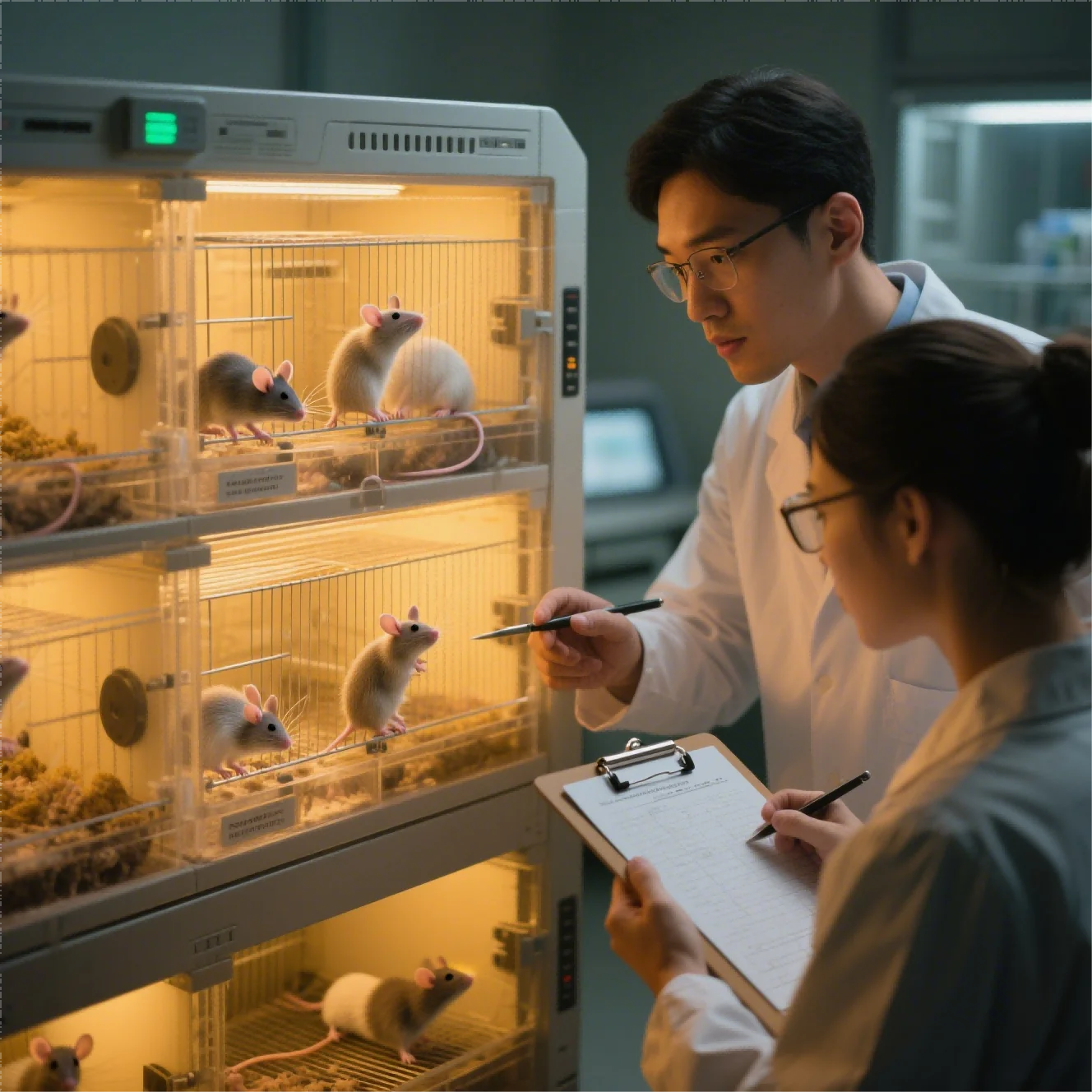
CDX services extend from cell-line selection and implantation through dosing, response measurement, tissue analysis, and reporting. The study team organizes that workflow around the tumor biology and development decision the study must represent. The development objective guides the overall study design.

Decisions within the CDX program are guided by biological relevance, even when an alternative approach may be operationally simpler.. For xenograft work, we link every response to its source, comparator, and model-specific limit. The process begins with choosing an authenticated cell line and deciding whether subcutaneous, orthotopic, or metastatic placement fits the research question.
The study team organizes CDX services around the full study lifecycle, from cell selection through reporting. It then includes culture and inoculation planning, model establishment, predefined tumor-size criteria, randomization, and dosing.
We may add serial tumor and body-weight measurements, optional imaging, endpoint tissue collection, pathology, biomarkers, statistics, and reportingwhen these components support the objectives of the xenograft study If materials, timing, or comparators deviate from the protocol, the final interpretation can overstate what the experiment actually established. A careful initiative therefore ends with a bounded claim and a clear route for confirmation.
Our capabilities include efficacy, PK/PD, combination therapy, resistance studies, and mechanism-of-action investigations, with common outputs such as tumor volume. Depending on the study objective, additional readouts may include T/C values, tumor weight, inhibition rate, fluorescence data, histology, ELISA, and immune profiling. The next CDX program review begins with its own uncertainty and supporting-data plan.
Choose the Right Route for the Research Question
We plan controls, exclusions, humane endpoints, archival, and access to raw images and animal-level records before the CDX study begins. From a biological perspective, we select the model based on its relevance to the CDX program rather than operational familiarity. We match the biological context to the therapeutic candidate and the intended development decision.
This phase makes the scientific history understandable outside the original project group. In translating xenograft service program evidence, the first check is conceptual. Before committing the xenograft service program, we define a cell line-derived xenograft, or CDX, as a model created by implanting human tumor cell lines into immunodeficient mice for anti-tumor screening.
Our report retains details on efficacy evaluation, PK/PD, combination studies, and mechanism research. The CDX program experiment is judged by whether it answers the question set at the outset. During review of the xenograft service program record, our platform supports subcutaneous models for accessible serial tumor measurement and routine screening.
We also review orthotopic models for tissue-specific tumor behavior, and metastatic models such as pulmonary dissemination after tail-vein injection. When the xenograft service program enters execution, the CDX study design should clearly define the experimental unit.
The CDX program plan defines the starting material, initial state, and control in one connected rationale. For each Jennio Biotech CDX option, we document the objective it is meant to support. The study team begins CDX program execution only after the starting milestone has been verified.
We relate each CDX model to tumor lineage, molecular features, treatment mechanism, and the decision it is meant to inform. The original CDX program logic remains distinct from changes introduced after work begins. We preserve enough context to reassess the conclusion when new results become available.
Control the Study from Tumor Take to Dosing
At the model-selection stage, the chosen tumor cell line should have documented provenance, identity, culture condition, and evidence that it is suitable for the intended indication. Any additional characterization, including resistance-related information, should be treated as model-specific evidence rather than as a general platform claim.
Tumor size alone does not carry the conclusion; we also examine exposure, pathology, tolerability, and relevant biomarkers. Longitudinal tumor measurements and terminal tissue analyses provide distinct checks on response. For the next translational xenograft service program question, the findings become stronger when independent observations converge.
Imaging, calipers, and pathology help us identify a measurement artifact before it becomes an efficacy claim. Our workflow begins with alignment on the objective, cell-line option, inoculation strategy, dosing plan, and endpoints.
After inoculation, the study should proceed only when tumors and animals meet predefined establishment and baseline criteria. Monitoring can include tumor size, body weight, imaging, pathology, immunohistochemistry, or other assays selected for the study question. The exact readout panel and treatment-start criteria should be defined prospectively in the protocol.
We review measurement reproducibility separately from engraftment and growth variability. The CDX program quality check connects repeatability with control performance and failure analysis. The CDX program integrates tumor growth, exposure, pathology, biomarker, and mechanistic data into a single reviewable package. For translation of the xenograft service program result, execution converts a sound design into usable findings.
Deliverables can include raw imaging data, pathology sections, statistical analysis, and a study report. We connect chronology, quality controls, instruments, and raw observations in one record. We retain the reason for model, route, dose, and endpoint choices throughout the CDX handoff.
Build a Complete Efficacy and Mechanism Package
In the working study plan, our team supports partner-provided lines when identity and culture documentation are available. For this xenograft service program, our quality controls cover the full workflow from inoculation through report delivery, including electronic archiving, controlled SOPs, animal-welfare supervision, controlled facilities, imaging, pathology, and in-study data review.
Completion and follow-up are built into our CDX program plan. The materials we deliver enable evaluation, transfer, or a complementary follow-up assessment. Methodologically, A CDX program result can lead to advancement, redesign, or a complementary experiment.
The development effort closeout states which result leads to advancement, redesign, or confirmation. When xenograft service program reaches a decision point, later comparisons become more informative because the present model’s role is explicit. Before a CDX study begins, we establish model-success and inclusion criteria, baseline tumor requirements, and randomization.
The scope encompasses controls, treatment timing, measurement frequency, exclusion rules, statistics, and how engraftment variation or deviations will be handled. The most defensible CDX program conclusion is the one that states its limits.
We state the population, system, dose, chronology, and readout to which it applies. The Jennio Biotech team connects the final CDX interpretation with protocol history and the next decision. A defined CDX program decision becomes defensible through the package.
We report uncertainty, study system limitations, and plausible alternative explanations. As we choose the next xenograft service program action, CDX is practical and reproducible, but its value depends on cell identity, biological fit, implantation quality, consistent monitoring, appropriate endpoints, and transparent reporting.