Successful oncology CRO partnerships begin with agreement on what the model must prove, who is responsible for each decision,, and how uncertainty will be handled. The level of control and confirmation should match the consequence of a wrong oncology decision. In an oncology CRO collaboration, we begin with a shared development question and agree on whether the program needs CDX, PDX, orthotopic, metastatic, or humanized models.

A staged oncology program may move from rapid screening to more biologically complex confirmation as uncertainty decreases. The required resources should therefore be selected according to the decision at each stage rather than included simply because they are readily available. That discipline allows scientific judgment to guide scope, timing, and resource use together. Without a shared decision rule, teams may interpret the same response in incompatible ways.
We revisit the study design choice when material new findings emerge. This move lets an independent team review the basis for each study conclusion. We limit the resulting claim to the evidence collected.
We support partnership quality through clear ownership, a written communication cadence, milestone reviews, predefined success criteria, early discussion of model take and model performance and animal status, transparent protocol-change handling, and delivery of raw data with interpretation. The study team connects model choice, dosing, measurement, pathology, exposure, and reporting so each result informs the same oncology decision.
Align the Model with the Development Question
The CRO collaboration should begin only after the starting milestone and study objective are verified. The sponsor and study director should define responsibility for program strategy and evidence requirements at the outset. For each oncology model, we explain how tumor biology, treatment mechanism, and the intended decision fit together.
We operate as a specialized preclinical efficacy CRO and drug-evaluation platform that integrates model development, drug screening, and in vitro studies. We use the record to connect in vivo efficacy evaluation, non-GLP pharmacology and toxicology, and specialized platforms for innovative therapies. The study team selects the system for its relevance to the study objective, not because it is familiar.
The study system should match the candidate’s biology and development stage. A preclinical oncology CRO should connect model selection, controls, dosing, and readouts with the next development decision. Before execution begins, the central check is whether the experiment can actually resolve the intended scientific question.
At this stage, the relevant question is not how many capabilities a provider can list, but whether the selected resources fit the study objective. Depending on the program, CDX or PDX models, imaging, pathology, immune analysis, and PK/PD may be combined when each contributes to the same development decision.
Our oncology capacity combines authenticated tumor materials with CDX or PDX models, longitudinal imaging, pathology, immune analysis, and PK/PD assessment. An oncology study design starts from a defined experimental unit. For the study design, we align biological source, baseline condition, and comparator before execution.
Build Transparency into Every Milestone
Controlled execution turns the design into usable evidence. The study team connects timing, controls, instruments, and raw observations in one record. The report should explain how the study evidence supports the interpretation. An efficient timetable has value only if the evidence still answers the scientific question.
A later preclinical program stage calls for its own controls, readouts, and acceptance criteria. The study team selects from tumor lines, xenograft systems, imaging, tissue analysis, and exposure tools based on the oncology question.
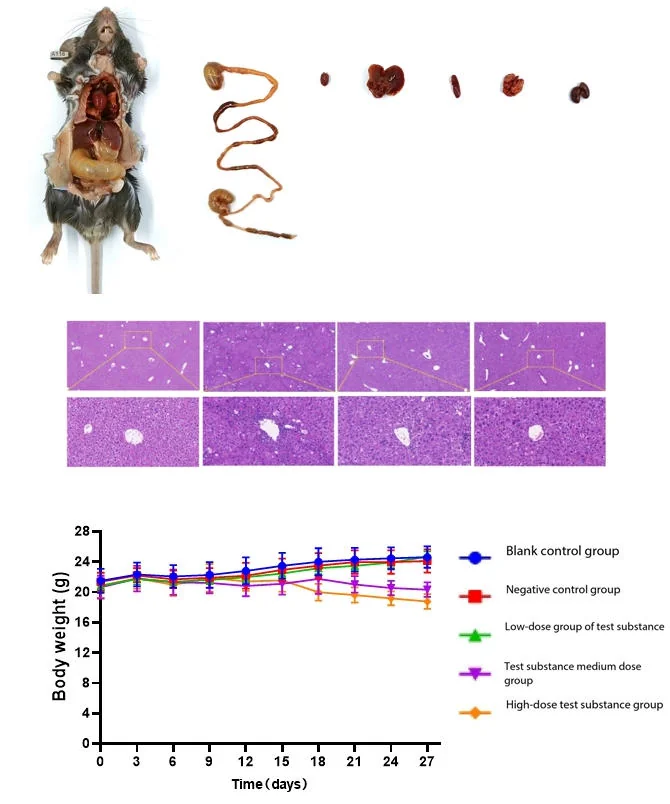
Tumor response is read alongside exposure, pathology, tolerability, and relevant immune findings. Imaging, caliper measurements, and tissue analysis give us complementary views of the same treatment effect. At Jennio Biotech, each model choice is connected to a shared study objective. The evidence becomes stronger when independent observations converge.
The readout package should remain focused on the oncology question. Cell-based assays can provide an early mechanistic view, while tumor models, imaging, pathology, immune analysis, and exposure measurements can provide complementary evidence when they are relevant to the candidate’s mechanism. Agreement between those readouts helps us distinguish a biological response from measurement noise.
A related part of the record covers metabolic and chronic-disease models, cardiovascular and orthopedic research. The defined question determines whether we include early pharmacology and toxicology, tumor vaccines, cell therapy, inhalation therapy, liver disease, and molecular delivery. Assay precision and model behavior are reviewed separately before we interpret efficacy. We examine study controls, precision, usable signal range, and the causes of failed runs.
Turn Vendor Management into Scientific Co-Ownership
A report creates practical value by clarifying the next action. We coordinate cellular activity, mechanism, whole-animal efficacy, PK/PD, biomarkers, pathology, and preliminary safety within one development effort.
Uncertainty, model limitations, and plausible alternative explanations should remain visible in the report. In collaborative oncology studies, we give equal weight to customized study design, biosafety, reproducibility, authenticated materials, standardized procedures, traceable records, scientific review, and animal-welfare oversight.
The preclinical program should be planned through completion, handoff, and follow-up. The evidence package should support program review, transfer, and targeted follow-up studies. We evaluate a preclinical oncology CRO through model fit, execution quality, and transparent reporting. We use the evidence to determine the next development action, which may be advancement, redesign, or confirmation in another system.
Possible next routes should be defined before the final interpretation is written. We define scope, validation status, relevant regulatory considerations, and decision responsibility before study initiation. Our Jennio Biotech closeout links the principal finding to the decision it can responsibly support.
A strong oncology collaboration should end with more than a positive efficacy figure. The final package should show which model was used, how exposure and pathology support the response, which limitations remain, and what evidence is still needed before the program advances. Jennio Biotech uses this closeout step to keep the next development decision tied to the data actually generated.